Why frontline vacancies stay open and what to fix


If you hire drivers, cleaners or store staff, you have probably tried the usual fixes already. More job boards. A higher hourly wage. An agency on standby. The vacancies stay open anyway.
The short answer: frontline vacancies stay open because there are too few workers who meet the requirements, not because employers advertise too little. Higher pay and more ads don't grow that pool. What an employer can fix is the leak between application and first shift: slow follow-up, ghosting and day-one no-shows. Track how many accepted candidates actually start, not applicants or hires.
About the data: this article is based on publicly available data. We use Dutch and European sources where they exist (CBS, UWV, STL, Netbeheer Nederland) and US surveys only where no European figures were available.
What are the biggest hiring problems for frontline employers?
Large frontline employers face six hiring problems, and two of them (4 and 5) sit mostly inside their own process. We ranked them by how often employer surveys report them and how directly they cut production or service.
- Too few suitable people apply. Vacancies stay open, shifts run short, growth stalls. (CBS, 2026; UWV, 2025)
- Applicants can't be deployed: wrong skills, licence or experience. More applicants don't turn into more hires. (UWV, 2025)
- Hiring to train moves the bottleneck to trainers. New hires are in, but can't work on their own yet. (UWV, 2025; Netbeheer Nederland, 2025)
- A slow, heavy application process loses candidates. Candidates are gone before HR or the manager acts. (Tellent, 2024 data; iCIMS, 2025)
- Ghosting and day-one no-shows. A planned shift runs short on day one. (CIPD, 2024; Indeed, 2023)
- The offer doesn't match what candidates accept: pay, hours, rota. Late declines and drop-outs after the offer. (UWV, 2025)
The rest of this post takes them in three groups: the shortage (1 and 2), why the usual fixes fall short (3 and 6), then the leaks you control (4 and 5).
Why do frontline vacancies stay open?
Frontline vacancies stay open because two problems stack: too few people apply, and many who do can't start the job yet. The labour market cooled a little in 2025, but neither problem went away.
CBS has asked Dutch businesses every quarter since Q3 2021 what holds them back. Staff shortage has topped the list every time. In the July 2026 survey, 32.8% of non-financial businesses named it as their main obstacle. In transport and storage it was 40.9%, in industry 26.6% and in construction 25.0%.
UWV's 2025 employer survey shows the same picture from the hiring side. On average, 45% of an employer's vacancies were hard to fill, down from 53% in 2023 and 2024. 58% of employers said the tight labour market hinders them.
UWV also asked those employers why. Skills and experience come up almost as often as applicant numbers, because an applicant without the right licence, certificate or shift availability can't fill a shift.
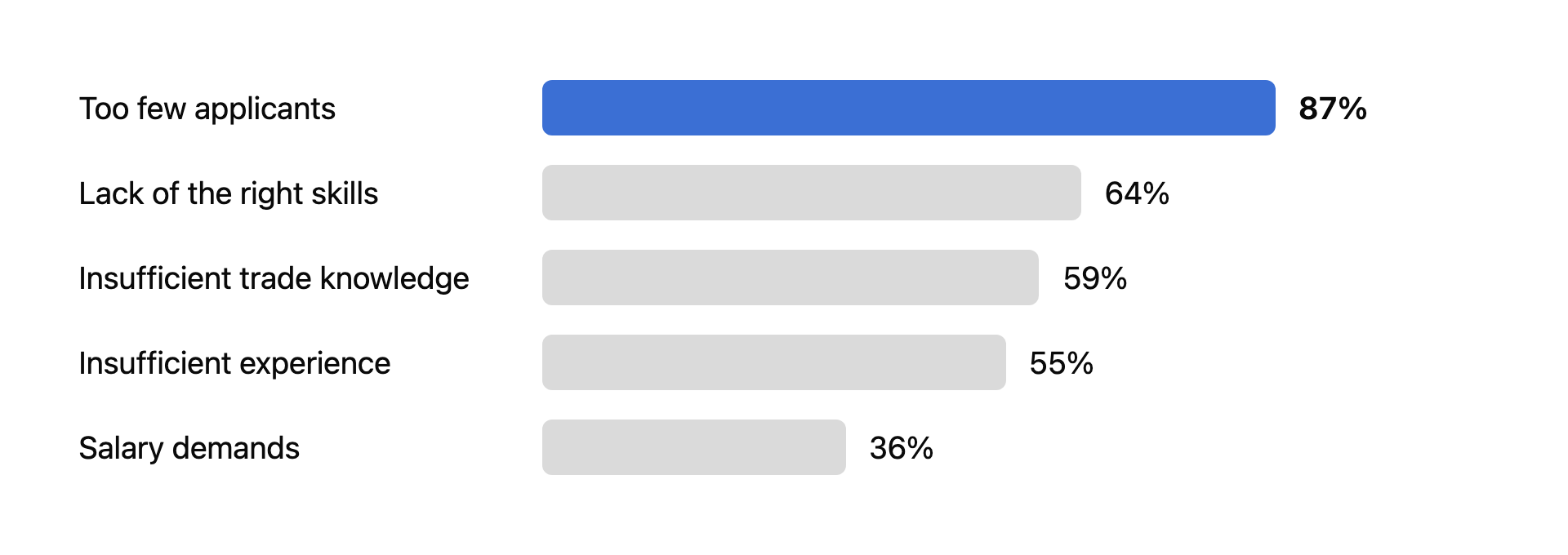
This lands hardest on large employers. In 2025, 60% of all Dutch vacancies were at companies with 100 or more staff and those companies had 28 vacancies open on average (CBS). In an earlier UWV survey (autumn 2024), 43% of employers hindered by the shortage said they couldn't grow because of it. 22% had to cut production, services or opening hours. At that point the shortage is an operations problem, not only an HR one.
The pool isn't about to grow either. Sector institute STL counted about 5,850 open truck driver vacancies in Q1 2026, while the number of drivers fell 1.2% to 92,535. Dutch grid operators and their contractors plan to bring in 5,000 extra technicians by 2030, out of roughly 30,000 people they need (Netbeheer Nederland, 2025).
Why don't higher pay and more job ads fix it?
Higher pay, more ads and more agencies help one employer for a while, but they don't add workers to the market. When every employer raises the wage, the price of a forklift driver goes up and the number of forklift drivers stays the same.
US construction shows this most clearly. In the 2026 survey by the Associated General Contractors of America (1,830 firms), more than 8 in 10 firms raised hourly craft pay at least as much as the year before. Still, 88% of firms with craft openings said those roles were as hard or harder to fill than a year earlier.
Dutch employers have also lowered the bar. Among employers with recent vacancies, 52% now more often hire people who still need training and 44% more often offer a no-obligation introduction (UWV, 2025). That widens the pool. It also moves the bottleneck from recruiting to training.
The Dutch grid sector says so outright. Netbeheer Nederland called limited training and supervision capacity the main bottleneck for its technician plan (November 2025). Every new hire who isn't ready yet takes hours from an experienced colleague who would otherwise be on the job.
These fixes all work on the size of the pool and the size of the pool is the part an employer controls least.
Where do frontline candidates drop out?
Frontline candidates drop out at three points: while applying, while waiting for an answer, and on the day they're due to start. Unlike the shortage itself, these leaks are in your own process.
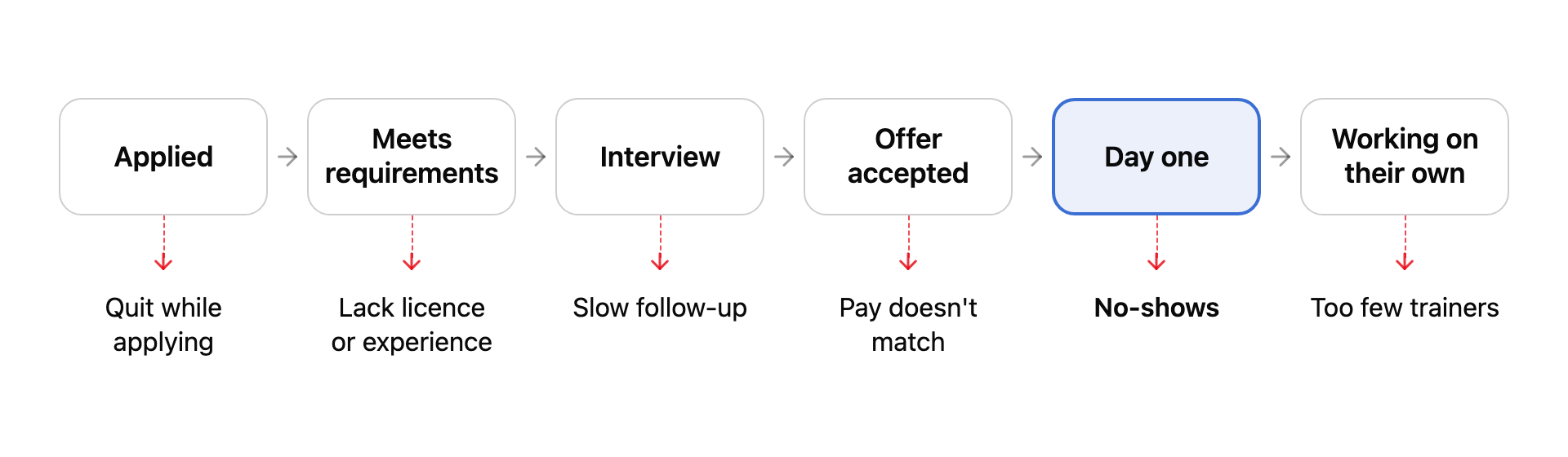
While applying. In 2024 data from recruitment platform Tellent (more than 8 million applications, mostly in Benelux, DACH and France), 41.5% of applicants dropped out at the very first step: entering their details and CV. In the Netherlands and Belgium, the time from application to job confirmation averaged 37.1 days. In a US survey of hourly workers, the top reason to quit an application was that it took too long (iCIMS, 2025).
While waiting. A frontline candidate applies to several jobs at once, often after a shift or at the weekend. The employer that calls back first gets the conversation. One of our customers put it this way: "20% of our applicants go cold before we reached them."
After saying yes. In the UK, 27% of employers that recruited in the past year had a new starter who didn't turn up on day one, and 41% saw new hires resign within their first 12 weeks (CIPD, 2024). In a survey of 4,517 ghosted employers in the US, UK and Canada, 89% said ghosting causes a problem for their business (Indeed, 2023).
The most expensive version is the day-one no-show: a candidate who accepted the job and doesn't turn up for their first shift. In an office, a missing starter mostly costs a recruiter time. In a warehouse or a plant, the shift was planned around that person. The roster says the role is filled. The line says it isn't.
What should you measure instead of hires?
Measure how many qualified people actually start, and when, not how many apply or sign. A hire count treats someone who never turns up the same as someone who does. Show-up rate fixes that: the share of candidates who accepted an offer and actually started on day one.
Swap each standard hiring metric for the question operations actually asks:
- Applicants per vacancy: how many applicants meet the hard requirements (licence, certificate, shift)?
- Time to hire: how many days until the person works their first shift?
- Offers accepted: how many of those people show up on day one?
- Hires: how many work on their own by the date the site needs them?
- Cost per hire: what does one filled, productive shift position cost?
- Open vacancies: how much production or service capacity sits behind them?
Track these per site, per role and per week. A company can hit its annual hiring target and still have one distribution centre short of night-shift pickers every week.
How can employers reduce candidate drop-off and no-shows?
Close the leaks you control before you buy more reach. Six steps, roughly in order of effort:
- Answer within minutes, evenings and weekends too. A callback on Monday morning reaches someone who already said yes elsewhere.
- Screen on the hard requirements first. Licence category, certificates such as forklift or VCA, shift pattern, region, language. Your trainers then spend their hours on people who can actually start.
- Shorten the application. No account, no long form. A phone number and one tap are enough to start the conversation.
- Say pay, hours and shift pattern up front. A candidate who learns the rota at the offer stage is a late decline.
- Confirm before day one. A call or message the day before, and on the morning itself. Have the next candidate ready to step in when someone drops out.
- Call past applicants before you post a new ad. Your ATS holds people who applied last season and already know the work.
Where Ringtime fits
Ringtime takes over steps 1 and 2 for frontline employers. It messages every applicant on WhatsApp within minutes and follows up by phone until they answer. It asks your knockout questions and books qualified candidates straight into your team's calendar.
What Ringtime can't do is create workers who don't exist, or add trainers to your floor. It makes sure the candidates you do get hear from you first. See how it works for employers.
FAQ
Why do frontline vacancies stay open?
Two problems stack. Too few people apply, and many who do apply lack the licence, certificate or shift availability the job needs. In the July 2026 CBS survey, 32.8% of Dutch businesses named staff shortage as their main obstacle.
Does higher pay fix frontline hiring?
Not for the market as a whole. Higher pay helps one employer for a while, but it adds no workers. In the 2026 AGC survey, more than 8 in 10 US construction firms raised hourly craft pay and 88% still found those roles as hard or harder to fill.
What should employers measure instead of hires?
Measure show-up rate: the share of candidates who accepted an offer and started on day one. Track it per site, per role and per week, together with the number of days until the first shift.
How can employers reduce no-shows in frontline hiring?
Answer applicants within minutes, also in the evening and at the weekend. Say pay, hours and shift pattern before the offer. Confirm the day before and on the morning of day one, and keep the next candidate ready.
Sources
- CBS, Conjunctuurenquête Nederland, derde kwartaal 2026: belemmeringen (6 Aug 2026)
- CBS, De arbeidsmarkt in cijfers 2025: de vraag naar arbeid (2026)
- UWV, Werkgeversonderzoek 2025: daling moeilijk vervulbare vacatures (18 Feb 2026)
- UWV, Krapte op de arbeidsmarkt: wat werkgevers doen om personeel te werven (18 Feb 2026)
- UWV, 59 procent werkgevers worstelt met krapte (autumn 2024 survey, published 2025)
- STL, Sectormonitor 1e kwartaal 2026 (18 Jun 2026)
- Netbeheer Nederland, Netbeheerders en aannemers zetten samen in op 5.000 extra technici (14 Nov 2025)
- AGC, 2026 Workforce Survey Analysis (Aug 2026, 1,830 firms)
- iCIMS, 2025 State of Frontline Hiring (16 Sep 2025)
- Indeed, Ghosting in Hiring Report (Dec 2023, 4,517 employers who had been ghosted)
- CIPD, New starter no-shows: over a quarter of UK employers have been ghosted by new recruits on day one (25 Sep 2024)
- Tellent via ANP, Twee op de vijf sollicitanten haakt al af bij het eerste sollicitatieformulier (16 Sep 2025; 2024 data, 8 million+ applications)
BLOG